

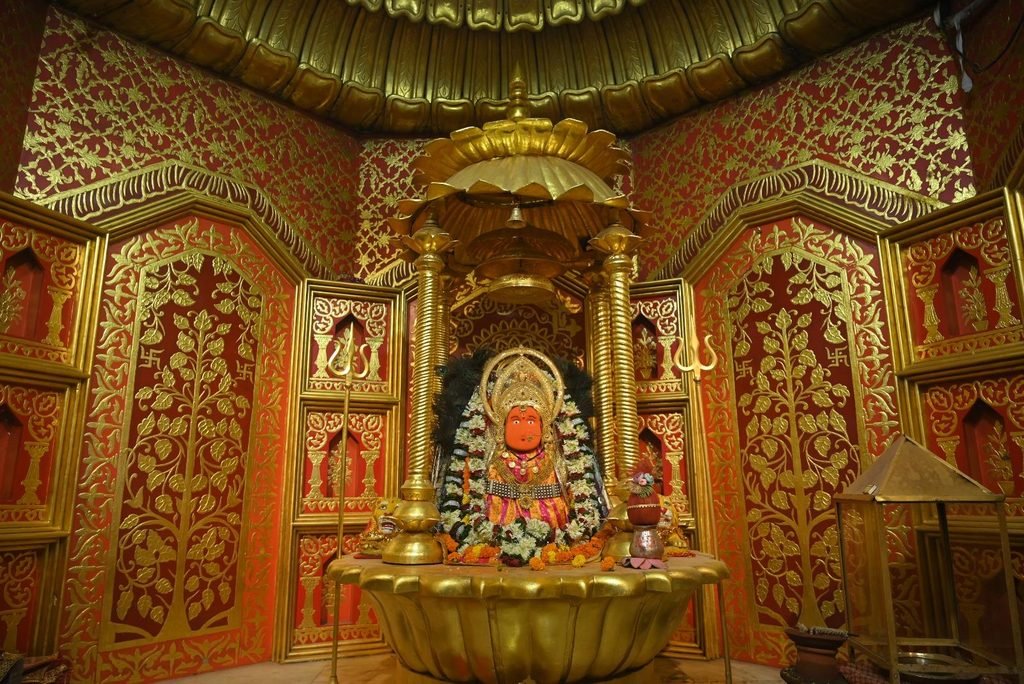
The sacred soil of Chhattisgarh is renowned across India for its raw natural beauty, vibrant tribal culture, and ancient temple architecture. Nestled in the Rajnandgaon district of this fertile land lies Dongargarh—a pilgrimage destination that inspires instant peace and profound devotion. Perched 1,600 feet above the plains amid dense forests, rolling hills, babbling streams, and wide reservoirs, the sanctuary of Maa Bamleshwari Devi stands as a beacon of faith for millions of devotees.
Known in antiquity as Kamakhya Nagari and Kamawati Puri, Dongargarh represents far more than religious devotion. Its hills preserve over 2,200 years of dynastic heritage, Kalachuri and Gond stone sculpture, and the tragic legend of Kamkandala and Madhavnal.
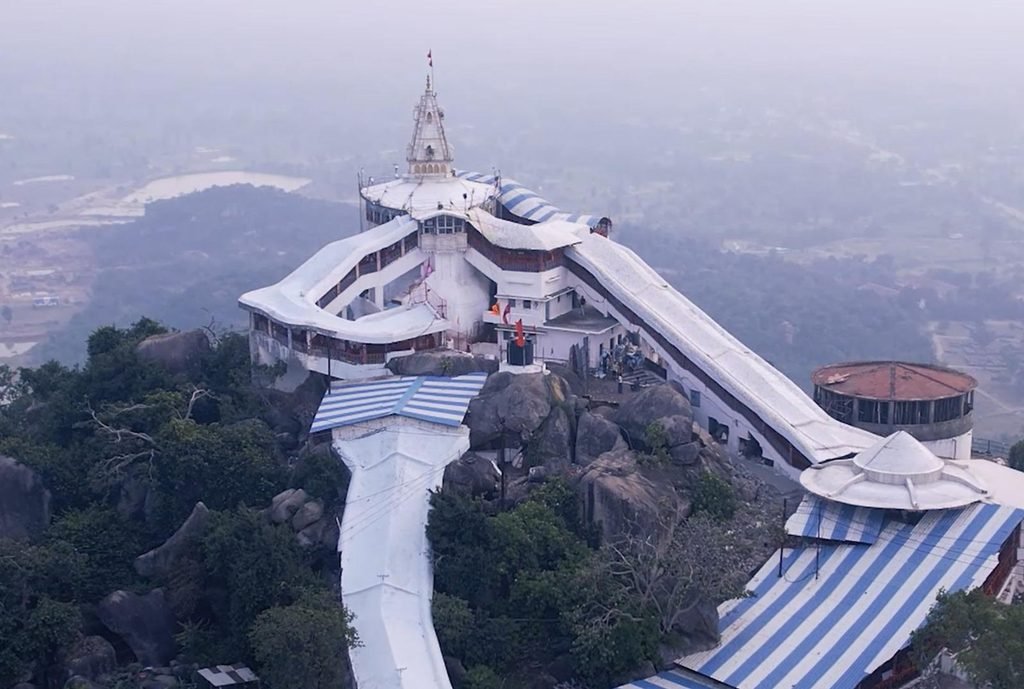
Natural Setting and Geography
The geographical landscape of Dongargarh sets it apart from typical temple towns. In the local dialect, Dongar translates to “hill” or “mountain,” while Garh means “fort”—signifying a secure, hill-guarded settlement.
- Reservoirs on Three Sides: The town is sheltered by three key water bodies: the Paniyajob Reservoir to the west, the Dhara Reservoir to the north, and the Madiyan Reservoir to the south. These bodies of water maintain water security for the settlement and moderate the local climate throughout the year.
- Lush Mountain Ridges: The green foothills of the Satpura range and the steady hilltop breezes offer cool respite to pilgrims after their ascent.
The Twin Shrines: Badi Bamleshwari and Chhoti Bamleshwari
Dongargarh’s most defining feature is that the Divine Mother is venerated here in two distinct sanctums:
1. Badi Bamleshwari (The Hilltop Temple)
Situated atop the highest ridge of Dongargarh at an altitude of approximately 1,600 feet, this shrine houses the principal deity, Badi Bamleshwari.
- The 1,000-Step Ascent: Reaching the hilltop temple on foot requires climbing roughly 1,000 stone steps. Devotional chants of “Jai Mata Di” echo along the stairway, driving the steady rhythm of the climb.
- Modern Ropeway Facility: For elderly pilgrims, young children, and differently-abled individuals, a modern ropeway (cable car) service operates from the base to the temple entrance, covering the distance in minutes while offering panoramic aerial views of the valley.
2. Chhoti Bamleshwari (The Plains Temple)
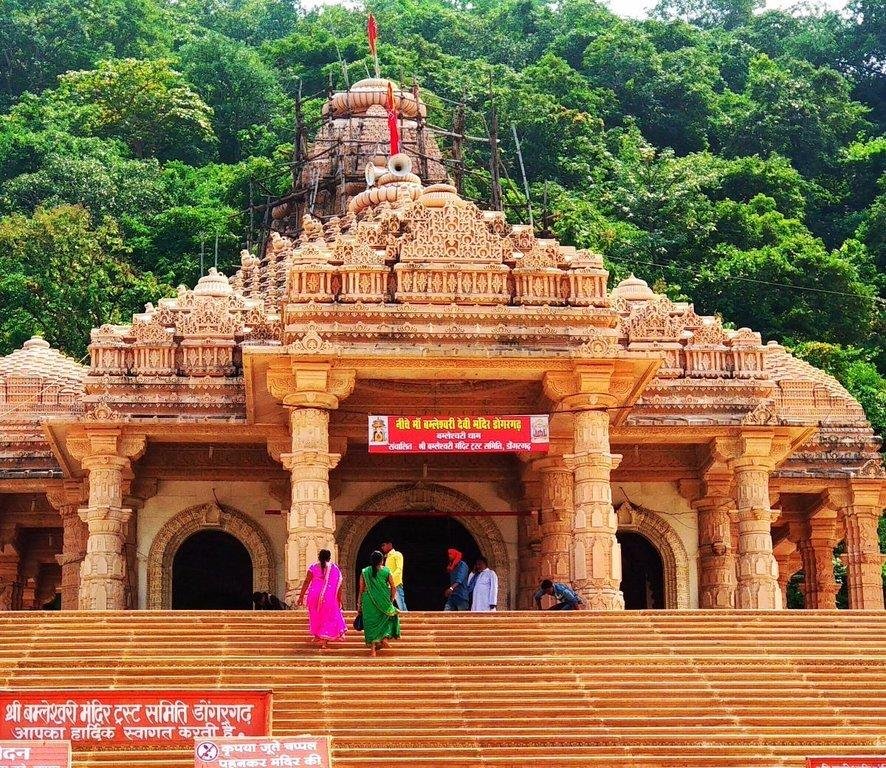
At the base of the hill on level ground sits the sister shrine, Chhoti Bamleshwari. Traditional belief holds that a pilgrimage to Dongargarh remains incomplete until one pays respects at Chhoti Bamleshwari following the hilltop visit. This lower temple welcomes high foot traffic year-round.
Historical Heritage: From Kalachuri Rule to the Gond Dynasty
Dongargarh is an archaeologically significant settlement where surviving ruins and fragments continue to offer insights into central Indian antiquity:
- Kalachuri Architectural Influence (12th–13th Century CE): The stone remnants, carved pillars, and lintels recovered from Dongargarh display architectural motifs characteristic of Kalachuri builders from the 12th and 13th centuries.
- Gond Artistic Imprint (Up to the 16th Century CE): Sculptures recovered throughout the area feature full lips, distinct facial structures, broad foreheads, long hairstyles, and traditional tribal jewelry—hallmarks of indigenous Gond sculpture. Historical evidence indicates the Gond kings held firm administrative control over Dungarakhya Nagar through the 16th century. Under their patronage, communal stability and trade allowed stonecraft, sculpting, and domestic architecture to flourish.
2,200-Year-Old Divine Founding: King Veersen’s Quest for an Heir
Historical folklore dates the spiritual origins of the hill back roughly 2,200 years to the reign of King Veersen, who ruled over what was then called Kamakhya Nagari.
- A Childless Monarch: King Veersen was a righteous, equitable ruler who cared deeply for his subjects. His treasury was full and his borders secure, yet he had no heir to continue his line.
- Austerity at Mahishmati Puri: Acting on royal counsel, King Veersen and his queen traveled to Mahishmati Puri (modern-day Mandla in Madhya Pradesh). On the banks of the sacred Narmada River, they undertook rigorous spiritual penance dedicated to Lord Shiva and Goddess Durga.
- The Divine Boon: Moved by the king’s devotion, Lord Shiva and Goddess Durga granted him the boon of a son. A year later, the queen gave birth to an heir, whom royal astrologers named Madansen.
- Consecration of the Temple: To commemorate this divine grace, King Veersen erected a grand sanctuary on the highest hill of Kamakhya Nagari, dedicating it to Jagadambe-Maheshwar—a composite manifestation of Shakti carrying the transcendent energy of Shiva (Maheshwar). Over centuries of linguistic evolution in local speech, this title transformed into Maa Bamleshwari and Bamlai Devi.
Prince Madansen eventually succeeded his father, ruling with the same devotion to the public welfare. His own son, King Kamsen, later ascended the throne; under Kamsen’s artistic patronage, Kamakhya Nagari came to be known as Kamawati Puri.
The Immortal Romance of Kamkandala and Madhavnal
Dongargarh’s cultural legacy is inseparable from the romance between the court dancer Kamkandala and the master musician Madhavnal.
A Connoisseur’s Ear and Royal Banishment
In the royal court of King Kamsen lived the gifted dancer Kamkandala. One day, a traveling musician and master of the veena named Madhavnal visited the court. During a dance recital that had enraptured the entire royal assembly, Madhavnal detected two near-imperceptible performance errors: a missing ornamental bead from one of Kamkandala’s anklets, and a wax prosthetic on the mridangam accompanist’s thumb that slightly altered the rhythmic cadence.
Astonished by Madhavnal’s refined discernment, King Kamsen presented him with an exquisite pearl necklace from his own neck. Rather than keeping the prize, Madhavnal immediately bestowed it upon Kamkandala in tribute to her mastery of dance. Misinterpreting this independent gesture as courtly disrespect, King Kamsen banished Madhavnal from his domain.
Secret Meetings and Madanaditya’s Plot
Instead of leaving the realm entirely, Madhavnal sought shelter inside a natural cave high in the hills of Dongargarh. By then, deep mutual affection had taken root between the two artists. Assisted by her loyal companion Madhavi, Kamkandala slipped away to the hills under cover of night to meet Madhavnal.
Meanwhile, King Kamsen’s son, Prince Madanaditya—a cruel, self-indulgent heir—had grown obsessed with Kamkandala. Fearing his wrath, she treated him with cold formality. One evening, Madhavnal secretly slipped into Kamkandala’s home just as Madanaditya arrived with his personal guard. Though Madhavnal escaped through a rear passage, Madanaditya grew deeply suspicious and posted armed guards around her residence.
The two lovers continued their correspondence via letters carried by Madhavi. Eventually, Madanaditya caught the maid in transit. Broken by threats and bribes, Madhavi revealed the hidden cave and the romance. Enraged, Madanaditya imprisoned Kamkandala on charges of treason and dispatched a cavalry unit to capture Madhavnal.
The Intervention of Emperor Vikramaditya
Eluding his pursuers across the mountain trails, Madhavnal reached Ujjain to seek refuge at the court of Emperor Vikramaditya, celebrated throughout northern and central India for his justice and valor. Moved by the musician’s grief, Vikramaditya mobilized his army and marched toward Kamawati Puri to right the wrong.
A protracted siege followed. The forces of Kamawati Puri were defeated, and Madanaditya was slain in battle by Madhavnal. The devastation reduced the palatial quarters of Kamawati Puri to ruins. Only the rugged, enduring hills (Dongar) remained standing—setting the stage for the site’s eventual transition into Dungarakhya Nagar, and later, Dongargarh.
The Ultimate Test of Devotion and the Divine Boon
Following his victory, Emperor Vikramaditya decided to test the depth of the lovers’ commitment. He sent a messenger to Kamkandala falsely declaring that Madhavnal had fallen on the battlefield. Consumed by grief, Kamkandala cast herself into a nearby lake, ending her life on the spot. That reservoir remains preserved to this day as Kamkandala Talab.
When Madhavnal learned of her demise, he moved to take his own life in the same manner. Deeply remorseful for the tragic misunderstanding his test had caused, Emperor Vikramaditya invoked the supreme protector Goddess, Maa Baglamukhi, offering fierce prayers for divine intervention.
Appeased by their devotion, the Goddess revived Kamkandala. When granted a boon, Madhavnal asked:
“O Divine Mother, dwell eternally upon this sacred summit in your awakened, living form, so that no devotee who approaches this hill in search of solace ever returns empty-handed.”
The Goddess granted his prayer. Ever since, Maa Baglamukhi—worshiped locally as Maa Bamleshwari and manifesting the fierce protection of Mahakali—has overseen the hillock of Dongargarh.
Trust Administration and the Navratri Festivals
The Historic Accord of 1964: In 1964, the former ruler of the princely state of Khairagarh, Raja Virendra Bahadur Singh, formally transferred the administrative management and properties of the shrine to the Maa Bamleshwari Trust Committee, initiating structured long-term development.
The Radiance of Jyoti Kalash: During both Chaitra and Sharadiya (Ashwin) Navratri, Dongargarh hosts a massive religious gathering. A central feature of this festival is the ceremonial lighting of Manokamna Jyoti Kalash (votive oil and ghee lamps) across the temple halls and hill platforms. At night, the hillside glows with thousands of illuminated points of light, resembling a constellation resting on the ridge.
Peda-Yatra (Foot Pilgrimages): Hundreds of thousands of devotees travel on foot from across Chhattisgarh—including Raipur, Bhilai, Durg, Rajnandgaon, and Bilaspur—as well as the bordering districts of Maharashtra and Madhya Pradesh, completing long journeys barefoot to offer prayers.
Pilgrim Amenities and Facilities
The temple trust and local administration maintain extensive infrastructure to handle pilgrim traffic:
- Summit Infrastructure: The 1,600-foot hilltop platform features filtered drinking water stations, covered weather-protection corridors, high-intensity lighting for night trekking, emergency medical stations, and well-maintained sanitation facilities.
- Rest Areas and Dining: Both at the base and the summit, the trust runs subsidized dining facilities (Annakshetra) providing clean, vegetarian meals. Formal stalls offer certified offerings, coconuts, chunri, and devotional souvenirs.
- Lodging and Stay: The Shri Bamleshwari Temple Trust Committee operates large-capacity guest houses, dharamshalas, and dormitories. Additionally, clean budget hotels and private lodges are clustered near Dongargarh railway station and the primary bazaar.
How to Reach Dongargarh
Dongargarh offers direct rail, road, and air links to major regional hubs:
| Mode of Travel | Nearest Hub / Route | Distance and Connectivity Details |
| Air | Swami Vivekananda Airport (RPR), Mana, Raipur | ~100 km away. Raipur Airport provides direct flight connections to New Delhi, Mumbai, Nagpur, Hyderabad, Bengaluru, Kolkata, Chennai, and Visakhapatnam. Taxis and regular buses run directly from Raipur to Dongargarh. |
| Rail | Dongargarh Railway Station (DGG) | An important operational junction along the Howrah–Nagpur–Mumbai mainline. Most express, superfast, and passenger services make scheduled halts here. |
| Road | National Highway 53 (NH-53) corridor | Positioned 100 km from Raipur and 36 km from Rajnandgaon. Government transport buses, private coaches, and intercity cabs ply this route 24 hours a day along well-paved, multi-lane highways. |
Essential Travel Tips for Pilgrims
- Best Season to Visit: The cooler window between October and March offers the most comfortable weather for climbing.
- Avoiding Peak Crowds: If you prefer a quiet, contemplative visit, travel on regular weekdays (avoiding Tuesdays and Sundays). Navratri brings massive crowds, and wait times for darshan can be several hours long.
- Climbing the Steps: If you choose to climb the stairs, begin before dawn or after late afternoon to avoid direct midday sun. Wear supportive footwear and carry an adequate supply of water.
- Ropeway Operations: The ropeway experiences heavy queues on weekends, festivals, and during Navratri. Account for extra ticketing and boarding time in your schedule.
Dongargarh brings together spiritual practice, panoramic natural beauty, and preserved folklore. A trip up the hill of Maa Bamleshwari offers an enduring glimpse into the cultural memory and deep-rooted faith of Chhattisgarh.